








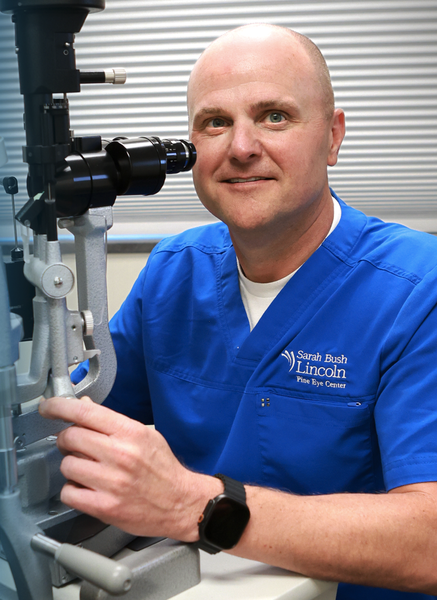
The old saying goes that there are only two things certain in life: death and taxes. For Sarah Bush Lincoln Ophthalmologist Ryan Pine, MD, the saying may as well be: death, taxes and cataracts.
“Cataracts are inevitable. If you live long enough, even if they are not that bad, you will get cataracts,” Dr. Pine said.
Cataract surgery itself is straightforward, but there are some pre- and post-operation factors to consider before moving forward. Dr. Pine breaks down what cataracts are and what to think about before surgery.
What are cataracts?
Cataracts are the clouding of the eye’s natural lens. Over time, through normal aging and light damage, the proteins in the lens deteriorate and cause that cloudiness. Cataracts are graded on a scale of zero to four. The best time to do cataract surgery is when they are grade two or three because that is when the cloudiness starts to get somewhat bad, yet it is still easy, both on me and on the patient, to do the surgery at that point. Letting a cataract get too bad could lead to it becoming brown and, eventually, could cause blindness in that eye.
How is cataract surgery performed?
We put steroid and antibiotic drops in the eye to get it ready, and then anesthesia is delivered through an IV. A very tiny incision, about half the length of a grain of rice, is made in the side of the cornea. We turn the hardened proteins into liquid with energy and vacuum them out, and then we place an implant in the lens. The surgery can take as little as eight minutes. Some people worry about the implant moving, but it stays secure.
Even though it seems pretty straightforward, you said there is a lot that people may not realize about the overall process. What should people keep in mind?
Cataract surgery is elective, so individuals have to decide if the cataracts are bad enough to warrant surgery. For the surgery itself, it is really helpful if the individual’s eye is not dry, so sometimes we have to treat dry eyes months before the surgery. There is a lot of measuring of the eye that we do before the surgery to do it right, so making sure the eye is not dry is a big factor.
The most important thing for people to know before the surgery is what they want out of it. For example, cataract surgery can “fix” near- or farsightedness, so patients need to know what they want their vision to be. Some people may be nearsighted their whole life, but even though the surgery fixes their distance vision, they may suddenly need readers to see near distances. We can tailor the power of the implant to how they want their vision to perform, so that’s a discussion I have with people before doing the procedure.
Cataract surgery can also correct astigmatism, so I discuss options for correction with patients who struggle with that.
You mentioned that cataracts are inevitable, but is there anything we can do to keep your eyes healthy and avoid cataracts longer?
Wearing a hat and sunglasses should theoretically help because they can reduce your eyes’ exposure to the sun’s rays. For eye health in general, eating foods like blueberries and other high-antioxidant foods, and keeping your overall health in order is ideal. At most, you can stave off the progression of cataracts a little bit, but they will happen no matter what.